
Web3 News
ZODES by ZERO TECH
Running ZODES by ZERO TECH: compiling a ZODE node on THE GRID, generating a Neural Key, and learning what decentralized infrastructure feels like.
What Running ZODES by ZERO TECH Actually Taught Me About Decentralized Infrastructure
Most people experience the internet as users. We log in, scroll, upload, consume. Last night, I did something different. I pulled the source code for THE GRID, compiled a ZODE, generated a Neural Key split into shards, encrypted a local vault, and connected my machine directly into a live peer-to-peer mesh. No account sign-up. No centralized server. No password reset email. Just cryptography, protocol… and typing cargo build more times than I care to admit.
Let’s be honest: nothing about compiling distributed infrastructure feels glamorous in the moment. There were errors. There was an “access denied” that turned out to be my own fault. There was that quiet internal debate of “is this worth it?” followed immediately by running the command again anyway. This is the unfiltered reality of running protocol instead of installing apps.
A ZODE is a node on THE GRID, a decentralized network built for secure compute, encrypted storage, and peer-to-peer coordination. When you run a ZODE, you’re not “using an app.” You’re participating in infrastructure. Your machine becomes a peer in a global mesh, a compute participant, a sector subscriber (like Interlink messaging), and a cryptographic identity holder. It’s closer to running a Bitcoin node than downloading a productivity tool — except instead of a clean installer, you get a compiler and a relationship with your terminal.
Git Hub Link for THE GRID:
GitHub – cypher-asi/the-grid: The Global Resilient Internet Datalink.
Before I could do anything, I had to generate a Neural Key. This isn’t a username and it’s not tied to Google. It’s a cryptographic keypair generated locally on my machine. The system splits recovery into shards using secret sharing. Lose the shards, lose the identity. There is no “forgot password” link waiting to save you. It’s empowering and mildly terrifying at the same time — which feels about right for sovereignty.
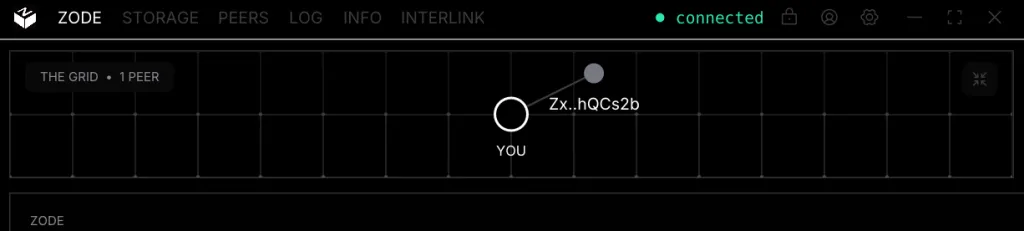
When my ZODE finally connected, it showed “Peers: 1.” After all that effort, one. Peer. I briefly wondered if I had just built a very expensive way to talk to myself. But here’s the important part: you don’t connect to everyone. You connect to a few stable peers, and the network spreads messages using GossipSub, Kademlia DHT routing, bootstrap discovery, and relay transport. You don’t need fifty direct connections; you need one healthy doorway into the mesh. From there, information propagates hop-by-hop. It’s emergent structure, not central coordination.
Peer selection isn’t based on geography. It’s based on cryptographic ID distance, reachability, responsiveness, and network health scoring. You might be connected to someone across the globe. The topology organizes itself according to protocol rules, not proximity. The internet underneath the internet doesn’t care where you live.
If peers drop to zero, you’re temporarily isolated — not exiled. The node continues attempting discovery via DHT lookups, bootstrap peers, and relay transport. The moment it reconnects to even one peer, it rejoins the mesh. This isn’t a fragile, single-server system. It’s dynamic, self-organizing, and occasionally humbling when you realize the bug was you all along.
Inside the GUI is Interlink, a decentralized messaging sector. When I sent a message and saw a checkmark, it meant the message was signed with my Neural Key, accepted by the program, and propagated through the pubsub mesh. There’s no centralized database storing it. There’s a distributed sector replicated across participating nodes. It feels different from posting on a platform. You’re not submitting content to a server; you’re injecting signed state into a protocol. And yes, it feels significantly better once it works.
We talk constantly about AI, sovereignty, ownership, and decentralization. But ownership begins at the infrastructure layer. If identity, compute, and coordination all depend on hyperscalers, you’re still renting the foundation. Running a ZODE shifts that mindset. It’s messier than downloading an app. It’s slower than clicking “Sign in with Google.” It occasionally makes you question your life choices. But it changes how you think about power.
What I learned is simple: decentralized systems aren’t magic; they’re math. They’re protocols executing local rules that create global order. You don’t need to connect to everyone — you need a healthy path. Identity without permission feels heavier, but more honest. Running infrastructure is quieter than using platforms, and more frustrating at first — but also more meaningful.
Most people use platforms. A few run protocol. After a few late-night builds and one stubborn executable, I joined the mesh.