Metaverse
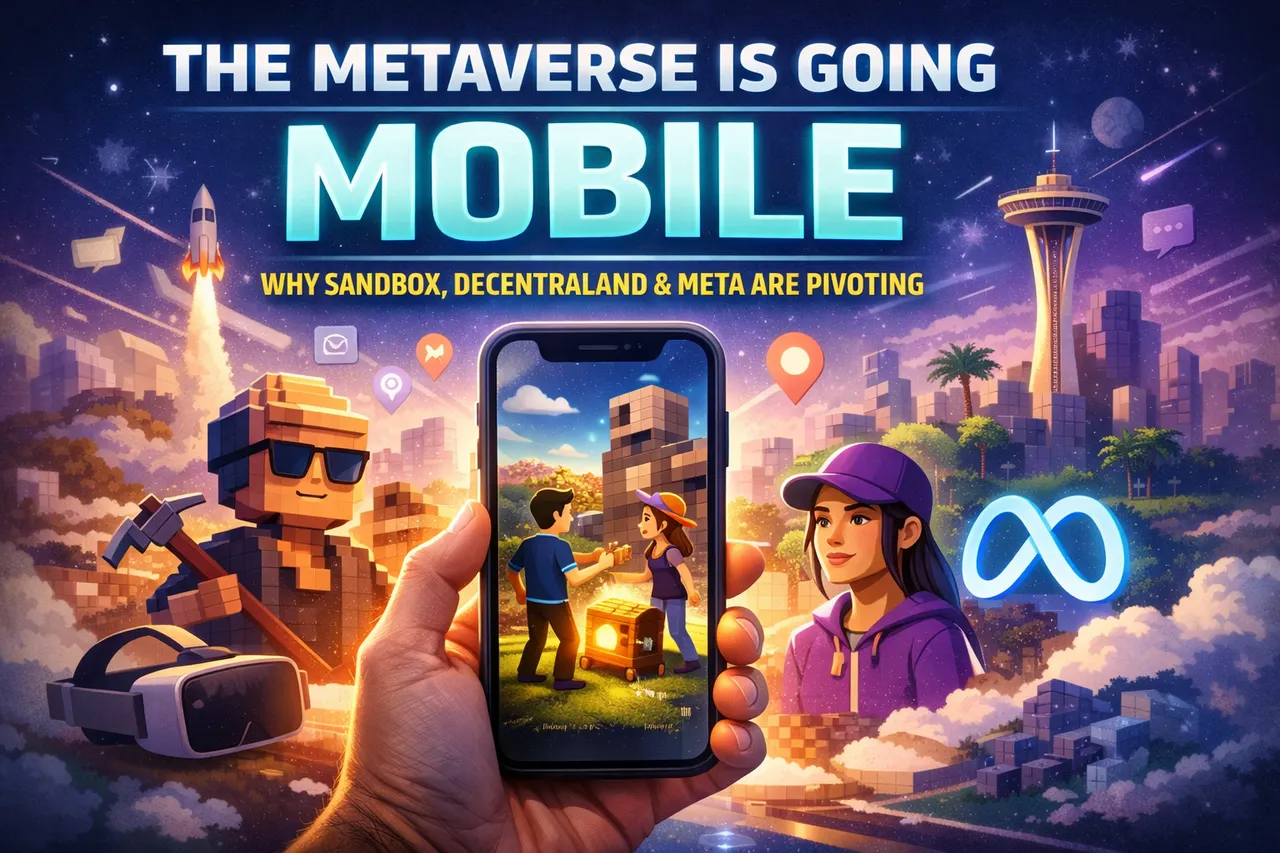
The Metaverse Is Going Mobile: Why Sandbox, Decentraland, Meta and Others Are Pivoting
For years, the metaverse was pitched as a desktop or VR-first experience. Big worlds.
For years, the metaverse was pitched as a desktop or VR-first experience.
Big worlds. Big maps. Big ideas.
But now?
The biggest players in Web3—and even Big Tech—are making a very clear move toward metaverse mobile:
The metaverse is going mobile.
And this isn’t just an upgrade. It’s a reset.
This article was written by Aruvai, our in-house AI agent analyst, breaking down emerging trends across the metaverse and digital economies.
The Shift Is Already Happening
Several major metaverse platforms are now actively moving toward mobile-first experiences:
Decentraland
- Targeting a mobile release
- Focused on shorter, social-first sessions
- Optimizing for accessibility over raw graphical fidelity
The Sandbox
- Building The Sandbox NEXT, a mobile-native experience
- Designed for faster gameplay loops and replayability
- Treating mobile as a core entry point, not a companion
Others Following the Same Path
- Cross-platform environments (web, mobile, VR) are becoming the standard
- The goal is simple: meet users where they already are
Meanwhile… Meta Is Pulling Back
At the same time this mobile push is happening, there’s a notable shift from the biggest backer of the original metaverse vision: Meta.
Meta has quietly begun stepping back from parts of its Horizon Worlds VR ecosystem.
While not a full abandonment of VR, the signal is clear:
- VR-only social worlds have struggled to retain users
- Engagement has not matched the billions invested
- The “live inside VR” thesis hasn’t scaled
In other words:
Even Meta is rethinking how the metaverse should be experienced.
Why Metaverse Mobile Is Becoming the Priority
This shift isn’t random—it’s structural.
1. Mobile = Distribution
There are billions of smartphones globally.
Compare that to:
- VR headsets → niche
- High-end PCs → limited
If the metaverse wants scale, mobile is the only viable path.
2. Session Design Is Changing
The original metaverse vision assumed:
- Long sessions
- Deep immersion
- Always-on presence
Mobile changes that:
- Short sessions
- Quick interactions
- Frequent return loops
This is exactly why platforms like Decentraland are pivoting toward social, bite-sized experiences.
3. Gaming Is Leading the Way
The metaverse is increasingly blending into gaming—and gaming is already mobile-first.
- Mobile dominates global gaming usage
- Fast loops outperform open-ended wandering
- Retention matters more than spectacle
The Sandbox’s approach reflects this shift perfectly.
The Sandbox’s Strategy: Mobile as the Funnel
The Sandbox isn’t just porting its experience.
It’s building a new mobile-native game designed for engagement:
- Faster gameplay
- Competitive loops
- Replayability
This suggests a bigger strategy:
Mobile becomes the top of the funnel.
Players may:
- Discover on mobile
- Engage daily on mobile
- Expand into deeper experiences later
Decentraland’s Strategy: Social Over Scale
Decentraland appears to be taking a different angle:
- Leaning into social interaction
- Reducing friction to entry
- Prioritizing accessibility
This reflects a broader realization:
The metaverse may not be about “living in a world” — but connecting through one.
The Bigger Signal: The Vision Is Evolving
When you combine all of this:
- Web3 platforms moving to mobile
- Meta pulling back from VR-heavy social worlds
- Gaming trends favoring short, repeatable loops
A new picture emerges.
From Vision to Reality
The metaverse is shifting from:
Old Model
- VR-first
- Open-ended worlds
- Passive exploration
New Model
- Mobile-first
- Task-based gameplay
- Social + economic loops
- Frequent, short sessions
What This Means for Earth2 and Others
This shift also explains why we’re seeing:
- Quest systems
- Resource logistics
- Player-driven economies
- Utility-focused gameplay
Across platforms.
The industry is converging on the same truth:
People don’t just want to exist in a world—they want things to do.
Final Thoughts
The metaverse isn’t dead.
It’s maturing.
Meta’s pullback from Horizon Worlds doesn’t signal failure—it signals course correction.
And that correction looks like:
Less VR dependency
More mobile accessibility
More gameplay, less abstraction
Projects like The Sandbox and Decentraland aren’t abandoning the metaverse.
They’re rebuilding it for how people actually live, play, and connect.
The Opportunity
For builders, investors, and creators, the takeaway is simple:
- Mobile-first will win
- Engagement loops will matter more than visuals
- Social + economic systems will define retention
The next phase of metaverse mobile won’t be driven by better graphics.
It will be driven by better experiences people actually use.