Metaverse · Web3 Gaming
I Built a Virtual World Around an Existing Community. Then Roblox Announced the Same Strategy.
No, Roblox didn’t steal my idea. But the timing was spectacularly rude. There’s a peculiar kind of frustration that comes with spending months quietly building something, only to open…
No, Roblox didn’t steal my idea. But the timing was spectacularly rude.
There’s a peculiar kind of frustration that comes with spending months quietly building something, only to open your news feed and discover that a company with considerably more money, resources, and developers has just announced something remarkably similar.
That was me on November 14, 2026.
And the company was Roblox.
To make matters worse, I discovered the announcement while reviewing an article published on my own website.
The irony was not lost on me.
There I was, months into independently developing a virtual world around an existing community, reading about Roblox and The Game Awards pursuing a remarkably familiar approach.
My immediate reaction was somewhere between excitement, disbelief, and a very dramatic internal scream.
But after looking more closely at the history of virtual gatherings, I realized something important.
Neither Roblox nor I invented this idea.
In fact, people have been experimenting with versions of it for decades.
And that makes the story considerably more interesting.
The Roblox Announcement That Hit a Little Too Close to Home
On November 13, Roblox and The Game Awards announced that the December 10, 2026 ceremony would be streamed inside Roblox’s virtual event venue, The Block.
Fans aged 18 and older will be able to experience the awards together inside Roblox, watching and interacting within a shared virtual environment.
We covered the announcement in our earlier article, The Game Awards Are Moving Into Roblox: Gaming’s Biggest Night Gets a Virtual Venue.
What caught my attention wasn’t simply that people would be watching a livestream through avatars.
It was the strategy behind it.
Take an existing audience. Give them a shared destination. Bring content they’re already interested in into that environment. Let them experience it together rather than separately.
Don’t build a world and hope an audience materializes.
Build around a community that already exists.
I read that and thought:
ARE YOU KIDDING ME?
Because that’s exactly how I’d been approaching a project I’ve been quietly developing for months.
Not at Roblox’s scale, obviously.
I’m fairly certain my entire development budget would qualify as a rounding error somewhere in their accounting department.
But the underlying thinking was remarkably familiar.
It Started With a Problem I Had as an Earth 2 Community Member
I’ve been part of the Earth 2 community for years, and keeping up with community broadcasts has always been more complicated than it needs to be.
Some creators stream on YouTube. Others use Twitch. Broadcast announcements appear across various Discord servers, social media accounts, and community channels.
Unless you’re regularly checking all those places, it’s remarkably easy to miss something.
And like many people, I have a demanding professional life, family responsibilities, and more competing priorities than hours in the day.
I don’t have time to monitor multiple Discord communities just to figure out who’s broadcasting tonight.
I suspected other Earth 2 community members were experiencing the same frustration.
So I started thinking about a way to bring those broadcasts together.
One curated destination.
One place to discover upcoming streams, find community creators, and catch up on past events.
No Discord scavenger hunt required.
That was the original problem I wanted to solve.
And a simple website with a broadcast calendar probably would have been sufficient.
Naturally, I decided to build an entire virtual world instead.
Because apparently solving a relatively straightforward problem by creating an immersive 3D environment seemed like a perfectly reasonable use of my spare time.
The Audience Was Already There
This distinction matters.
I didn’t start with a virtual world and then wonder how to convince people to use it.
I started with an existing community that already had content creators, audiences, friendships, conversations, and recurring activities.
The Earth 2 community didn’t need me to manufacture reasons for people to interact.
Those reasons already existed.
What was missing, at least from my perspective, was a convenient way to discover the community’s activities and a dedicated environment where people could gather around them.
I even secured e2.me/livestreamers, an Earth 2 property location (EPL), to establish another connection between the initiative and the ecosystem that inspired it.
The goal wasn’t to compete with Earth 2, Discord, YouTube, or Twitch.
It was to make an existing community easier to navigate and bring people together in another way.
And that’s how Elite City began taking shape.
Somehow, a Calendar Became an Entire World
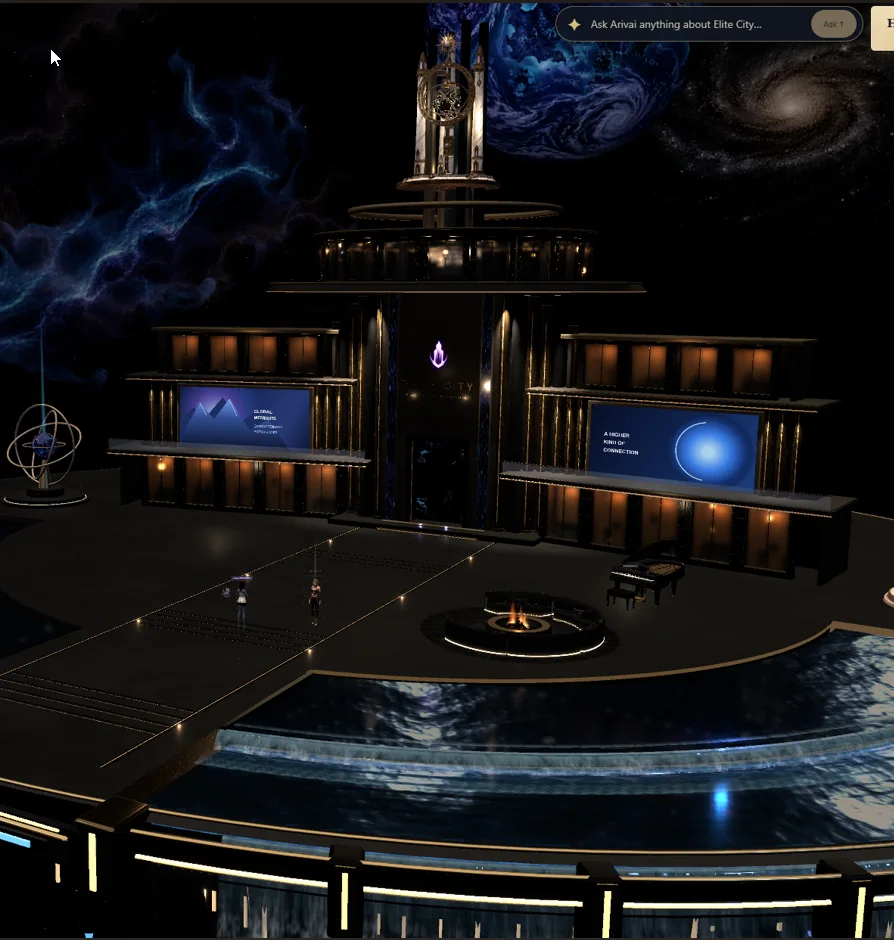
The original broadcast directory evolved into Elite City, an independent, interactive 3D social environment.
At the center is Celestial Commons, designed as a shared gathering space where people can explore, interact through avatars, watch broadcasts, and participate in hosted experiences.
The project gradually expanded to include additional spaces, member profiles, avatar interactions, and other social features.
Somewhere along the way, the visual ambitions escalated considerably.
What began as an effort to organize community broadcasts turned into floating architecture, elaborate environments, ongoing performance optimization, and an increasingly complicated relationship with AI coding assistants.
If you’ve ever used AI-assisted development tools to create something visually ambitious, you may understand this experience.
You ask for a small adjustment.
The AI enthusiastically makes the adjustment.
And then you discover that something else has inexplicably acquired a new shape, disappeared, or stopped working.
Let’s just say I’ve developed a newfound appreciation for the structural integrity of floors.
But underneath all the technical experimentation, the original purpose remained the same.
Bring people together around something they already care about.
The Calendar Is Still the Most Practical Part
Eventually, I came back to a realization that probably should have occurred to me much earlier.
If my original frustration was having to jump between platforms just to find broadcasts, requiring someone to enter a full 3D world to check a calendar would recreate the very inconvenience I was trying to eliminate.
So I made the broadcast calendar standalone.
The Elite City Earth 2 Broadcast Calendar is now publicly accessible without registration or entering the immersive world.
It provides a central destination for upcoming community broadcasts, past events, and available replay links.
I’ve also begun inviting selected creators to participate as Trusted E2 Streamers.
These creators can publish their Earth 2 broadcasts directly to the shared calendar, with links back to their existing YouTube or Twitch channels.
Their content stays theirs.
Their audiences stay theirs.
Their existing platforms and monetization remain unchanged.
Elite City simply provides another way for people to discover their broadcasts.
The calendar is the practical utility.
The virtual world is the social experience.
And importantly, neither requires the other to be useful.
Wait. Haven’t People Been Doing This for Years?
Yes.
And this is where the story gets interesting.
After my initial reaction to the Roblox announcement, I started looking at earlier examples of virtual communities gathering around shared events.
It turns out the concept has a surprisingly long history.
Second Life Was Hosting Virtual Concerts in 2006
In August 2006, Suzanne Vega performed a live concert for an audience inside Second Life.
BBC Radio 1 also experimented with bringing music events into the virtual world.
These weren’t simply videos embedded on webpages. They were attempts to create shared experiences for people participating through virtual identities and environments.
The technology was different. The visual quality was different. The infrastructure was different.
But the basic premise was familiar.
Give people a reason to gather somewhere digitally and experience something together.
Fortnite Turned Existing Audiences Into Virtual Eventgoers
In February 2019, Fortnite hosted a virtual concert featuring Marshmello.
In April 2020, Travis Scott’s Astronomical event took the idea even further.
These events demonstrated how a large gaming platform could turn entertainment into a shared, immersive experience.
The distinction is that Fortnite already had an enormous audience.
Rather than asking people to adopt an entirely new platform to attend a concert, the events met them in an environment they were already using.
AltspaceVR Was Hosting Community Conferences Years Ago
AltspaceVR provides an especially relevant example.
In February 2020, the Educators in VR International Summit brought educators and technology enthusiasts together for a multi-day virtual conference across several platforms.
The event included presentations, discussions, scheduled sessions, and opportunities for participants to interact.
It also relied on event calendars to help attendees navigate activities.
That sounds remarkably familiar.
The people participating were already united by a professional interest. The virtual environments offered them another way to gather, learn, and connect.
VRChat Demonstrated Another Approach
VRChat communities have also used virtual environments for shared entertainment, social gatherings, and events.
Some experiences have connected immersive attendance with external viewing platforms such as YouTube and Twitch.
Again, the underlying idea wasn’t necessarily to replace existing content platforms.
It was to create a shared experience around content and communities that already existed.
And by this point in my research, I had to acknowledge the obvious.
Roblox wasn’t first.
I wasn’t first.
Apparently, we’ve all been rediscovering variations of the same idea for approximately two decades.
Which was comforting.
And mildly annoying.
If This Has Been Done Before, Why Build Another One?
This is the question that matters more than who thought of the idea first.
If virtual concerts, community gatherings, livestream viewing, and event calendars have existed for years, why continue building new platforms around them?
I think the answer comes down to relevance, convenience, and community.
A virtual world doesn’t become valuable simply because it exists.
It becomes valuable when people have a meaningful reason to enter it.
For some communities, that might be entertainment.
For others, it might be education, professional networking, creative collaboration, or shared interests.
In my case, it began with a very specific problem within a community I already belonged to.
I wanted a better way to find Earth 2 broadcasts.
I also liked the possibility of giving community members somewhere to gather around those broadcasts.
That doesn’t require creating the next Roblox.
It requires creating something useful enough for a specific group of people to want to use.
And that distinction shapes how I’m approaching Elite City.
The Real Challenge Isn’t Building the World
If anything, this experience has reinforced something I’ve been learning throughout development.
Building the world is only part of the challenge.
The harder questions come afterward.
Will people actually use it?
Will they return?
Will the social features make the experience more enjoyable than simply watching a stream directly?
Will the infrastructure remain reliable when multiple people arrive simultaneously?
And perhaps most importantly for an independently funded project, what will it cost to operate?
Those aren’t theoretical questions anymore.
Elite City is now live in an invitation-only beta.
The public broadcast calendar is available to everyone, while access to Celestial Commons is being introduced gradually so I can observe performance, stability, and actual usage.
There’s even a barebones Potato Mode for people using less powerful computers or mobile devices.
It isn’t particularly glamorous.
But neither is requiring someone to purchase an expensive gaming computer just to visit a virtual gathering place.
For now, the objective isn’t to attract thousands of people overnight.
It’s to learn whether this approach genuinely improves the experience for the community that inspired it.
Earth 2 Is the Beginning, Not the Boundary
Although Earth 2 inspired the project, Elite City isn’t intended to be exclusively for Earth 2 members.
The underlying concept can apply to many communities.
Professional groups already have recurring events and conversations.
Creators already have audiences.
Interest-based communities already organize gatherings and share content across multiple platforms.
The opportunity is to make those activities easier to discover while offering an optional immersive environment where participants can connect.
A virtual world doesn’t necessarily need to become an entirely separate digital universe.
It can be a gathering place that complements the platforms and relationships people already have.
That’s the broader idea I’m interested in exploring.
But I’m starting with Earth 2 because it’s a community I know, a problem I’ve experienced, and an audience that already exists.
So, Did Roblox Beat Me to It?
In terms of scale, resources, and an established platform?
Absolutely.
In terms of inventing the underlying concept?
Neither of us was remotely first.
Second Life, Fortnite, AltspaceVR, VRChat, and others have been exploring virtual gatherings and shared experiences for years.
I have no reason to believe Roblox knew about Elite City, much less borrowed anything from it.
And the more I researched the history, the clearer it became that this isn’t a new industry concept.
What is interesting is watching different companies and independent builders return to the same fundamental idea from different directions.
Roblox is bringing a major entertainment audience into an established virtual platform.
I’m building a smaller, independent environment around an existing community and a specific discovery problem.
Different scale.
Different execution.
Different resources.
A surprisingly similar belief that virtual experiences work best when people already have a reason to come together.
And perhaps that’s the real lesson.
Being first isn’t nearly as important as understanding who you’re building for, why they might care, and whether what you’ve created actually improves their experience.
Still.
After months of building, testing, redesigning, optimizing, and occasionally wondering why an avatar’s anatomy had become a creative interpretation rather than a biological suggestion, the timing of Roblox’s announcement was almost comically perfect.
I’m happy to see major platforms exploring the same direction.
I really am.
But just once, I’d appreciate the opportunity to finish something before the entire technology industry starts announcing similar ideas.
Is that too much to ask?
Apparently.
Explore Elite City
The Earth 2 Community Broadcast Calendar is publicly accessible, with no registration required.
Elite City is currently welcoming a limited number of invited beta visitors. Anyone interested in exploring the world can request an invitation.
The project is independently developed and funded, and I’m continuing to refine it based on real-world testing and community feedback.
Elite City. A world worth entering.
Caveat: Please excuse the occasional falling-through-the-floor incident. Management is aware of the issue and recommends avoiding sudden movements. 🥔🤣