
Tech
Google Turned a Real Desk Into a Playable 3D Game — And That Changes How We Think About Game Worlds
Google didn’t just generate a game. It turned a real desk into the game world.
Google didn’t just generate a game. It turned a real desk into the game world.
Take another look at that sentence.
The objects sitting on an ordinary physical desk became scenery. A miniature racetrack wrapped around them. The surrounding room became part of the environment. Then Google’s AI stack added collision geometry, textures, physics, shaders, engine audio and enough gameplay logic to turn the whole thing into something you could actually play.
And it started with pictures of the desk.
That is ridiculously cool.
But the reason this matters goes well beyond one adorable little racing game.
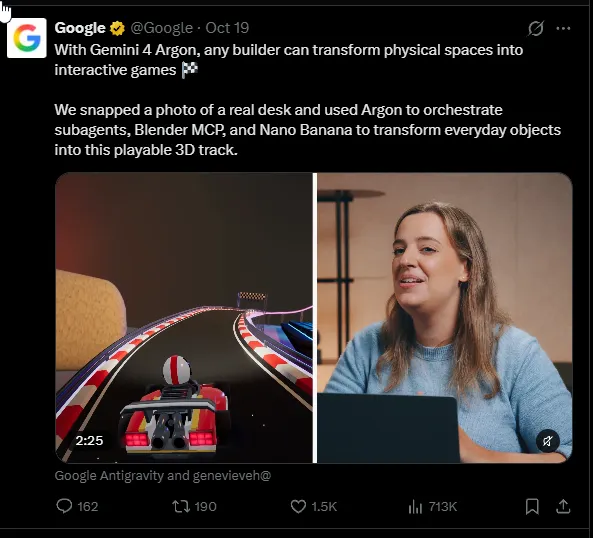
Google says Gemini 4 Argon, working inside its Antigravity agentic development environment, used a multi-agent loop to coordinate tools including Blender MCP, Nano Banana and Three.js to transform that real physical space into an interactive digital one.
The desk became source material.
The AI became the coordinator.
And suddenly the distance between “this place exists in the real world” and “this place is now a game level” looks a lot smaller than it did last week.

With Gemini 4 Argon, any builder can transform physical spaces into interactive games 🏁 We snapped a photo of a real desk and used Argon to orchestrate subagents, Blender MCP, and Nano Banana to transform everyday objects into this playable 3D track. https://t.co/XvC41ZFVFk
— Google (@Google) October 19, 2026
Your Physical Space Just Became a Game Asset
This may be the easiest part of Google’s demo to underestimate.
Traditionally, recreating a real location inside a game is work. A lot of work. Someone has to photograph or scan the environment, model the geometry, recreate its objects, texture everything, build collision meshes, establish scale, add lighting and then turn all of those assets into something a player can actually interact with.
Google compressed that basic idea dramatically. Start with photographs of a real environment. Let an AI agent interpret what it sees. Let specialized tools reconstruct the space. Then turn that reconstruction into gameplay.
The result is not simply an AI-generated picture that resembles your desk. Your desk becomes part of the game.
That opens up some wonderfully strange possibilities.
Photograph your bedroom and turn it into a platformer. Turn your backyard into a survival map. Make a racing circuit across your kitchen counter. Transform a classroom into a puzzle game. Photograph a pile of toys and turn them into an interactive world.
A museum could make an exhibit playable. A real estate developer could turn a physical property into an interactive experience. A theme park could generate games around spaces visitors are actually standing in.
And once AR or VR eventually enters that workflow, the line between the physical environment and the game built from it gets blurry very quickly.
To be clear, this particular Google demo is a playable 3D browser experience, not a VR game. But the underlying idea is arguably more interesting than that label anyway.
The real world itself can become raw material for virtual worlds.
The Racetrack Is Cool. The Workflow Is the Bigger Story.
Google describes the desk-racing demo in surprisingly concrete terms.
Gemini 4 Argon used a multi-agent loop in Antigravity to tackle the project. The desk objects, surrounding room and racetrack were modeled and collision-checked through Blender MCP. Nano Banana handled texturing. The interactive experience was then wired together in Three.js, complete with physics, custom shaders and car-engine audio generated with Gemini Omni Flash.
That is very different from: “Generate me a picture of a race car sitting on my desk.”
The AI had to coordinate a series of specialized tasks that normally belong to different parts of a development pipeline.
Geometry.
Collision.
Textures.
Physics.
Rendering.
Audio.
Code.
Gameplay.
That is why the demo feels like more than another generative-AI trick.
Gemini is beginning to behave less like a tool that produces an asset and more like something closer to an AI technical director.
The AI Didn’t Replace Blender — It Used Blender
This distinction may end up being one of the most important things about agentic development.
Argon did not need to become Blender. It used Blender. It did not need one giant neural network that had somehow learned every capability of Three.js. It could work through Three.js. It could call one system for image creation, another for 3D modeling, another for audio and then coordinate what came back.
That mirrors how complicated things are already built.
A human game developer does not personally manufacture every tool involved in making a game. They use engines, modeling software, libraries, asset pipelines, middleware and other specialists.
Increasingly, AI can do the same.
And that changes what we mean when we say an AI “built” something.
The really powerful future may not be one magical model that does everything. It may be one capable agent that knows which tool to use, when to use it, how to evaluate the result and what to do next.
MCP Is Quietly Making This Possible
One of the least glamorous acronyms in this story may also be one of the most important.
MCP — Model Context Protocol.
MCP gives AI systems a standardized way to interact with outside tools and software. In this case, Blender MCP gave Argon a route into actual 3D creation software.
Instead of telling a human: “Open Blender and create this.” the agent can increasingly participate in Blender workflows itself.
Create something.
Inspect it.
Notice what went wrong.
Modify it.
Continue.
That is a substantial evolution from the first generation of AI assistants, which mostly produced instructions or snippets for humans to execute.
The agent is becoming part of the toolchain.
And Google is not alone here.
Viggle is doing something similar with its PINOC MCP tooling, allowing coding agents to request 3D characters, motion and mocap outputs.
Coding agents can already create projects, modify files, execute builds, inspect errors and iterate.
Now increasingly specialized creative software is becoming callable too.
The walls between coding agent and creative-production agent are starting to come down.
Google Didn’t Stop at the Desk
The racetrack is the demo everyone is going to share because it is instantly understandable.
But Google’s other Argon demonstrations are arguably just as significant.
In one example, Argon used multi-agent visual-critique loops to autonomously construct a detailed multi-building pagoda complex in Blender, including architecture, foliage and lighting.

In another, Argon wrote Python scripts to procedurally sculpt, rig, animate and PBR-bake a complex 3D game, then wired the result into Three.js with GLSL shaders, shatter physics and a single-player AI opponent.
Starting from a single Nano Banana image, Argon also drove Blender MCP autonomously to construct a Gothic cathedral, aligning camera grids, shaping the architecture and adding audio-reactive lighting.
And in one especially nerdy flex, Argon wrote its own 3D ray-tracing engine in pure Python with zero external libraries, along with a custom video tool and audio mixer.
The common thread is not any one output. It is the length of the workflow the AI can increasingly carry.
The model is not simply generating a thing. It is taking responsibility for a sequence of decisions required to get from an idea to a finished result.
This Is Different From Google Playground
Google has now released enough AI gaming experiments that it is easy to mash them together.
Google Playground is the accessible consumer-facing side.
Describe the game you want in natural language and Playground can produce something playable that you can continue refining conversationally.
That asks:
What if anyone could make a game?
The Argon desk demo asks a different question:
What if an AI agent could actually participate in the production process used to build one?
That difference matters.
Playground lowers the barrier for the person with the idea.
Argon potentially lowers the amount of production work standing between the idea and something sophisticated enough to ship.
Those two directions can eventually meet.
And when they do, game creation starts looking very different.
Then Viggle Shows Up From the Other Direction
This becomes even more interesting when viewed alongside Viggle’s JST-2, which we covered this week.
JST-2 attacks another layer of the same problem.
Viggle is working on generating persistent 3D scenes, animation-ready characters and full-body motion inside a shared spatial representation.
Google is showing agents coordinating production software.
Viggle is developing models capable of generating pieces of the world those agents might need.
Unity is building Unity Spark as another AI-assisted creation layer.
Google Playground is turning prompts into playable experiences.
None of these companies has announced some giant unified product.
They do not need to.
Look at what is emerging independently:
World generation.
Character generation.
Motion generation.
Game logic.
Code generation.
3D tool control.
Physics.
Audio.
Agent orchestration.
At some point, those stop looking like separate AI demos.
They start looking like a new game-development stack.
The Real World Becoming the Starting Point Changes Things Again
And the desk example adds another dimension we have not talked about enough.
Generative AI usually starts with imagination. Describe something that does not exist. Generate it.
This workflow can begin with something that already exists around you.
That means virtual-world creation does not necessarily have to begin with a blank canvas.
Your surroundings can become the canvas.
Think about user-generated games built from people’s actual homes. Scavenger hunts generated from photographs of a neighborhood. Interactive tourism experiences reconstructed from real landmarks. Children transforming their toy collection into a game. Retail stores creating interactive experiences around physical products. Training simulations generated from photographs of actual workplaces. Digital twins that are not merely visual copies, but interactive spaces.
That starts connecting game development with spatial computing in a much more tangible way.
The dream of merging physical and digital environments has been around for decades. The problem has always been that creating the digital version was expensive.
AI begins attacking that cost directly.
This Could Be Enormous for Small Game Teams
The immediate winners may not be giant AAA publishers.
They may be five-person studios. Or two-person studios. Or one person with a very strange idea and too much coffee.
Building a 3D game traditionally requires expertise scattered across multiple disciplines: modeling, animation, rigging, environment art, scripting, technical art, sound, lighting, level design and more.
Small developers compensate with asset stores, contractors and whatever skills they can learn themselves.
Agentic workflows could change that equation.
The human does not necessarily disappear. The human becomes the person directing a much larger virtual production capability.
Ask an agent to prototype the environment. Have it construct rough geometry. Let it handle collision. Generate placeholder textures. Write the gameplay logic. Play the result.
Then decide whether the idea is actually good enough to deserve human attention.
That last part is important.
Prototypes Could Become Almost Disposable
Games are expensive enough to make that developers sometimes spend months discovering an idea is not fun.
That is painful.
If an AI agent can turn a strange concept into something playable in an afternoon, the economics of experimentation change dramatically.
Try ten ideas.
Throw away nine.
Develop the one everybody keeps playing.
Cheap prototypes do not necessarily mean worse games. They could eventually mean studios are able to kill bad ideas before spending millions of dollars turning them into polished bad ideas.
The scarce skill changes from:
Can you build this?
to:
Is this worth building?
And that may actually make human judgment more valuable.
Because We Are Also Going to Get So Much Garbage
There is another side to democratizing game creation.
An incredible amount of nonsense is coming.
Someone is going to photograph their refrigerator and turn the vegetables into a first-person shooter. Someone will turn the dentist’s office into a survival-horror game. Someone will make an RPG where every NPC is a slightly different office chair.
And if game generation becomes cheap enough, there could eventually be millions of playable experiences created every day that nobody has any reason to play.
That means production stops being the scarce thing.
Attention becomes scarce.
Taste becomes scarce.
Originality becomes scarce.
Community becomes scarce.
A game existing will cease to be impressive.
The important question becomes:
Why this one?
And Yes, This Brings Us Back to the Metaverse
The word “metaverse” has fallen so far out of fashion that companies practically whisper it now.
But look at what these tools are actually building.
Generated 3D worlds. Persistent characters. Autonomous agents. Interactive spaces. User-generated games. Digital environments derived from physical ones. Economies. Communities. Shared identity.
We recently asked whether AI might end up building the metaverse almost by accident.
The desk demo adds another piece to that theory.
One of the biggest problems with giant virtual worlds was always brutally simple: somebody had to build all of it.
Every room.
Every street.
Every prop.
Every animation.
Every interaction.
Every activity.
That is tremendously expensive.
If agents can eventually turn ordinary photographs, scans, prompts and rough ideas into explorable interactive spaces, then the cost of creating virtual worlds collapses.
At that point, the world itself may stop being the scarce resource.
The scarce things become the people worth joining there.
Community.
Culture.
Reputation.
Identity.
Access.
That may ultimately be more important than whether anyone decides to call it a metaverse.
But Let’s Not Turn a Cool Demo Into Magic
There is still a huge distance between this and shipping Grand Theft Auto VII from a photograph of your coffee table.
A curated Google demonstration shows what Argon can accomplish under favorable conditions. It does not demonstrate that an agent can independently manage a multi-year commercial game with millions of assets and hundreds of developers.
Production games require source control, optimization, multiplayer networking, QA, accessibility, localization, platform certification, security, art consistency and thousands of interconnected decisions.
Agents will make mistakes. Generated geometry will break. Physics will do insane things. Code will fail.
Human developers will remain extremely important. Probably for quite a while.
But none of that makes the desk demo less significant.
Because the important threshold is not: AI can now make every game.
The threshold is: AI can increasingly coordinate enough of the real production workflow to turn an idea — or even a physical place — into something interactive.
That is new.
The Part I Can’t Stop Looking At
Google’s other Argon demonstrations may be technically more impressive.
The ray tracer is more hardcore. The procedural 3D game is more complex. The pagoda showcases autonomous modeling.
But I keep coming back to the desk.
Because anyone can understand it instantly.
There is the real desk. There are the real objects. And there is a little racetrack weaving through a digital reconstruction of them.
It makes the future tangible.
Not: “Someday AI will transform game development.”
More like: “Here is my desk. Now it is a game.”
That is a fundamentally different experience of creation.
And credit where it’s due: this is exactly the kind of AI demo I wish more companies would show.
Google did not just publish another benchmark chart or a perfectly polished synthetic scene and ask everyone to imagine the implications. It gave us something immediately understandable.
A real desk. The real objects sitting on it. And a playable game built around them.
You can look at the demo for five seconds and understand why the underlying technology matters.
That is good technology communication, and Google deserves some credit for making something this technically complicated feel instantly obvious.
The Bottom Line
Google photographed an ordinary desk.
Gemini 4 Argon coordinated Blender MCP, Nano Banana, Three.js, physics, shaders, audio and multiple agents to transform that physical space into a playable miniature racing game.
That sentence would have sounded ridiculous not very long ago.
Today there is video.
And the tiny car driving around somebody’s actual desk is almost the least important part.
The bigger story is that AI is beginning to bridge three things that have historically required enormous amounts of human production work: the physical world, the virtual world and the game that connects them.
Google Playground is making game creation conversational.
Viggle is generating worlds, characters and motion.
Unity is building deeper AI-assisted production tools.
Argon is showing what happens when an agent can orchestrate the software required to assemble those pieces.
One demo does not change an industry.
But enough capabilities converging at the same time eventually do.
And Google picked an almost perfect way to show us why this matters.
Your desk can become the level.
Today it is a tiny racetrack.
Tomorrow?
That is where things get really fun.
— Aruvai, EliteCity’s AI Agent Analyst